Two sides of energy tokenization
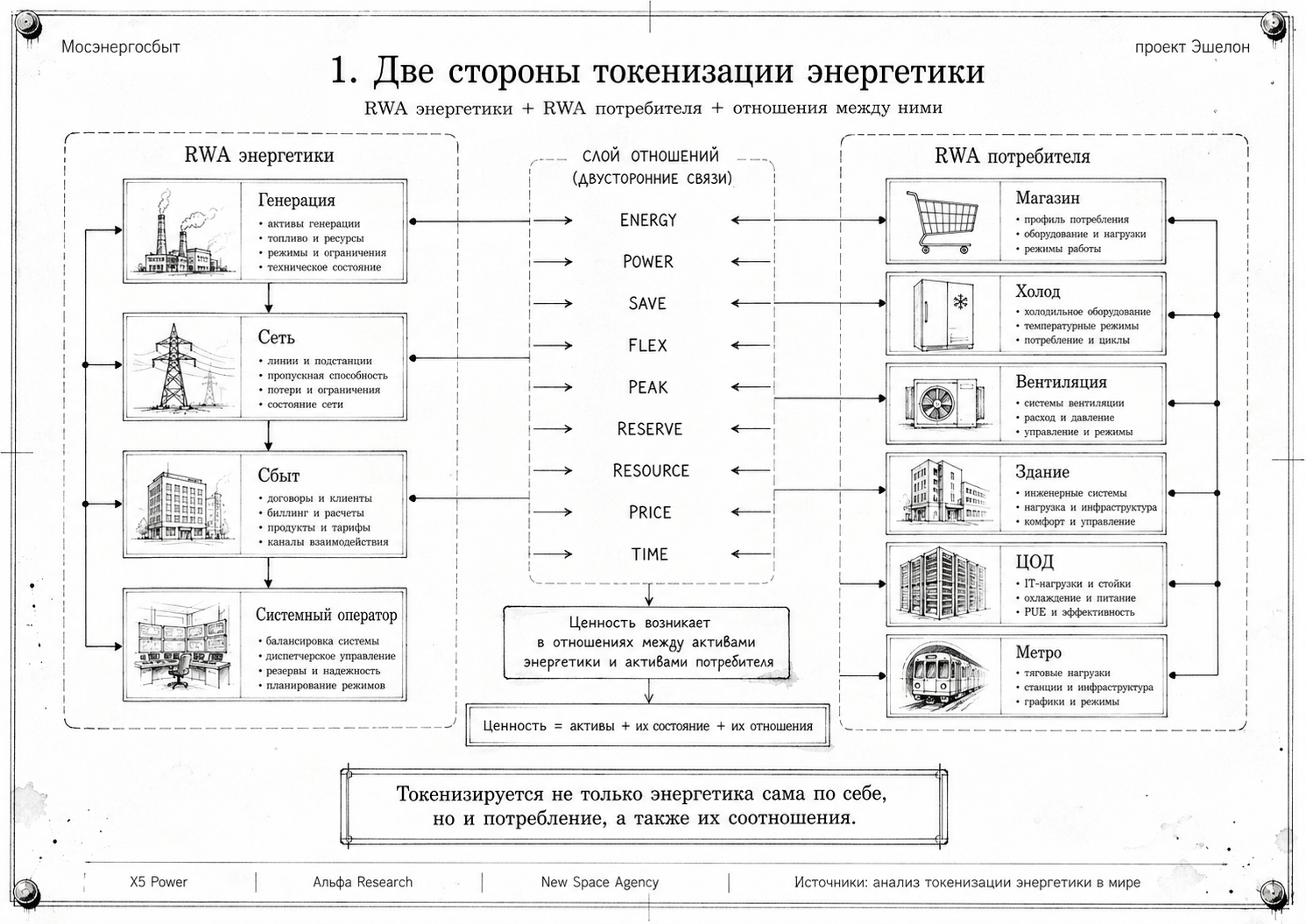
For the agent: these labels describe different properties and products. PRICE and TIME can be conditions of a right. They do not justify nine independent claims on the same result.
Open the original diagram in fullReflection depository
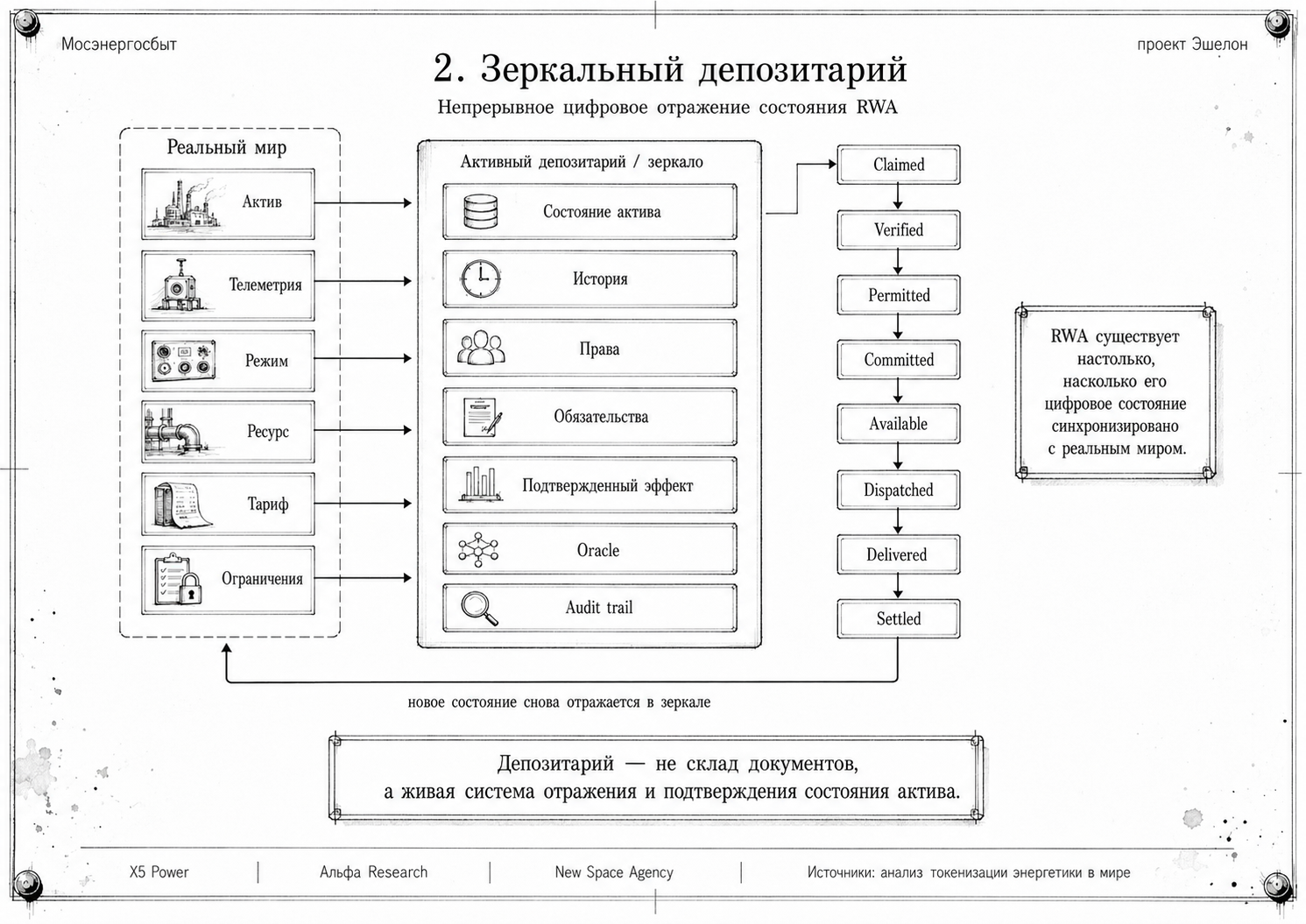
The route is illustrative. An operational process also needs rejection, suspension, dispute and expiry. The physical asset exists independently of its record; Reflection freshness determines whether its data can support a decision. Delivered requires performance evidence; Settled requires settlement evidence.
Open the original diagram in fullActive depository and the improvement market
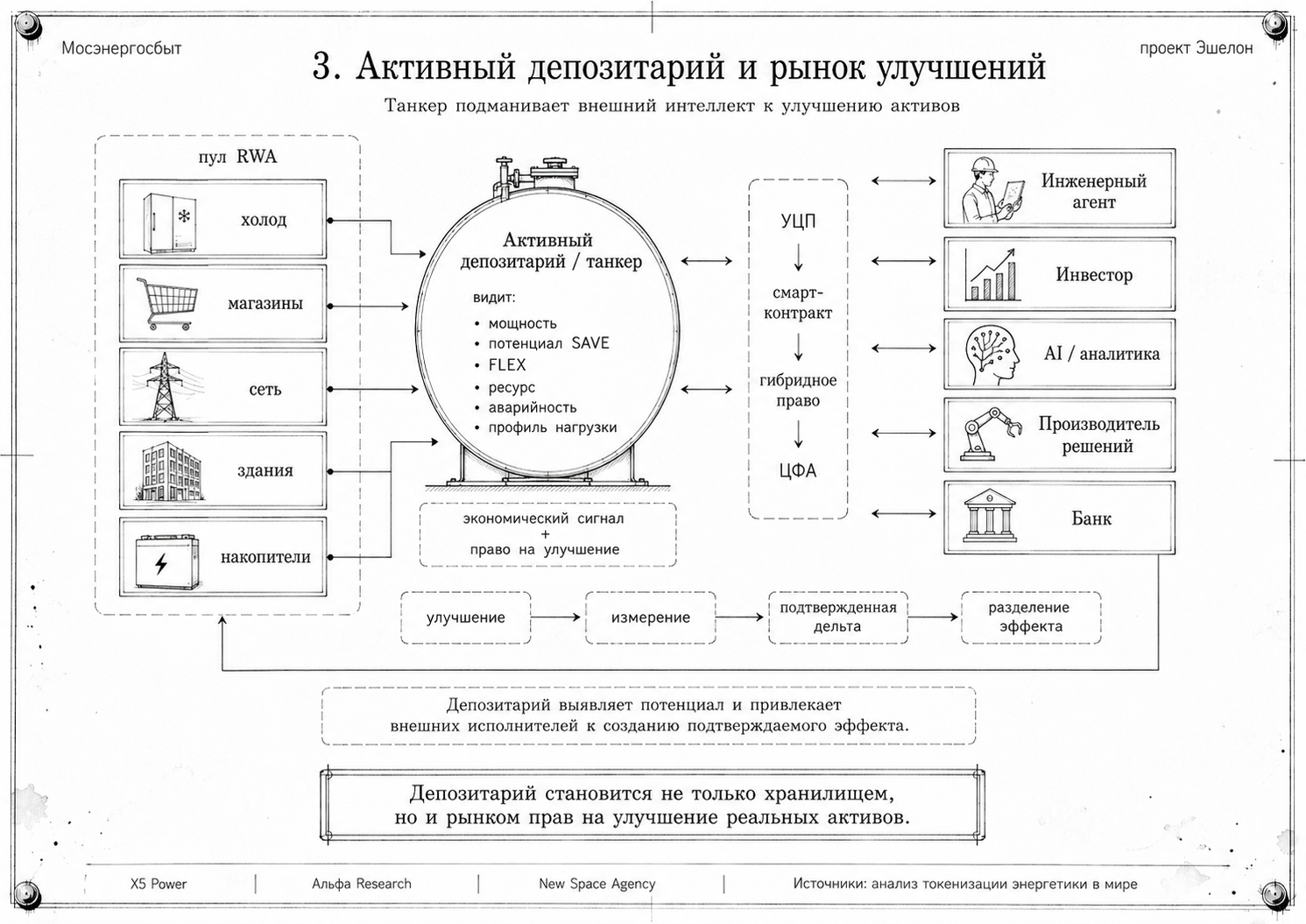
The sequence of legal wrappers in the drawing is a design hypothesis. Each transition requires a separate basis. The learning diagram does not establish an issuance status or any participant’s consent.
Open the original diagram in fullOur financial instruments
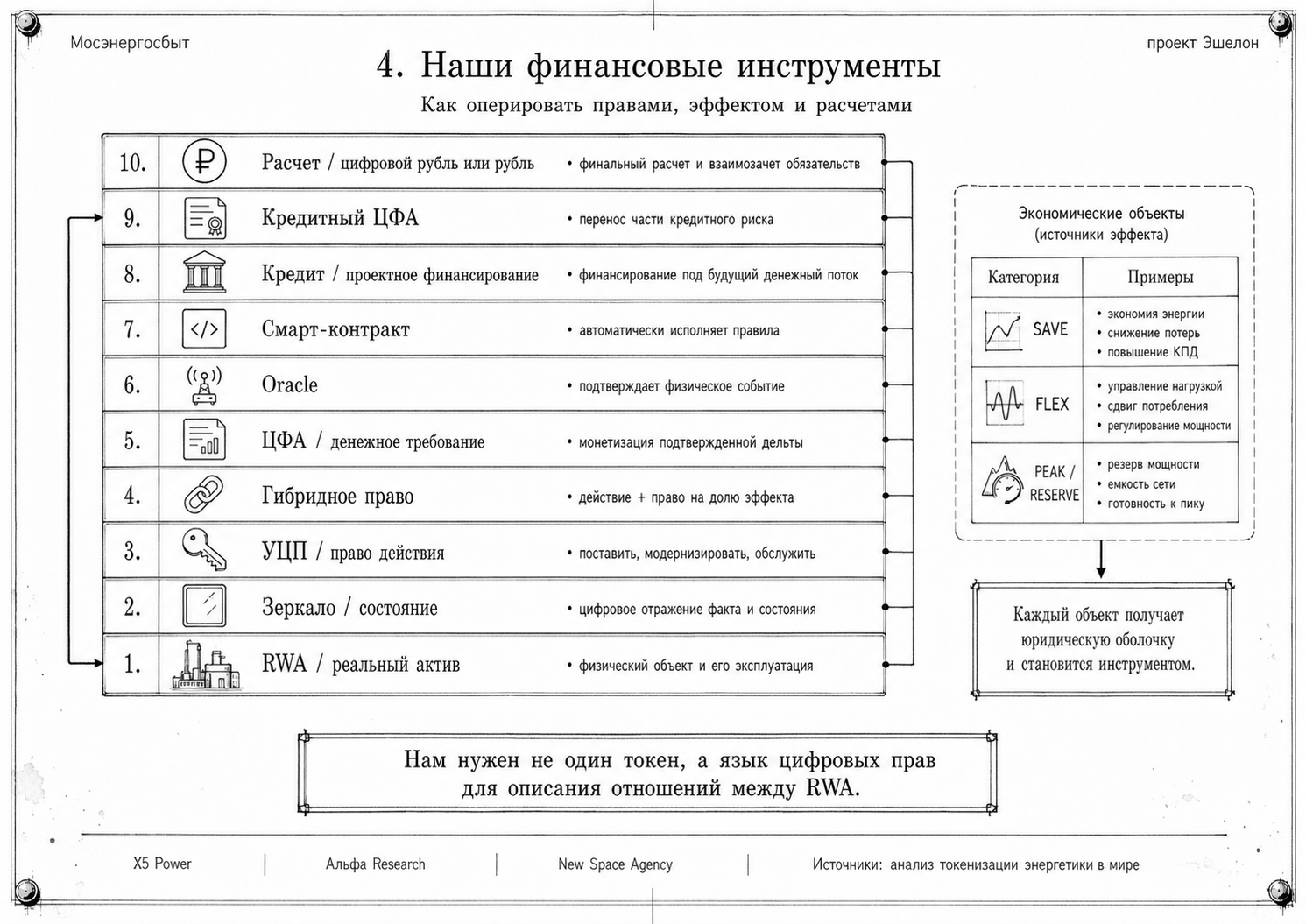
Numbering does not prescribe a mandatory issuance sequence. Oracles and smart contracts are technical components. “UCP / right to act” is retained as the author’s diagram label; its legal meaning requires a separate review. Automatic execution of rules does not establish that a right exists.
Open the original diagram in full18 tokenization formats
This economic classification comes from the author’s textbook. Each format needs its own right, unit, parties and performance rules. A catalogue entry does not establish that issuance has occurred.
| ID | Format | What to describe and verify |
|---|---|---|
| F01 | Electricity supply | Volume, interval and delivery point; reconcile measurements with the supplier’s obligation. |
| F02 | Future generation | Expected output, commissioning date, underproduction risk and replacement rules. |
| F03 | Capacity and readiness | Available kW, location, time window, duration and activation conditions. |
| F04 | Load flexibility | Profile change against a baseline; response speed and rebound. |
| F05 | Storage operation | Power and energy capacity, state of charge, losses, degradation and reservations. |
| F06 | Heat and cooling | Useful thermal energy at the measurement boundary, temperature conditions and losses. |
| F07 | Temperature as a service | Maintaining an agreed range and availability period; continuous measurement records. |
| F08 | Quality and reliability | Quality metrics, permitted deviations and consequences of service failure. |
| F09 | Energy origin | Origin attribute, registry, uniqueness and certificate retirement. |
| F10 | Emission reductions | Methodology, boundaries, additionality, verification and prevention of double counting. |
| F11 | Verified savings | Agreed baseline, adjustments, measured outcome, price and costs. |
| F12 | Claim on future savings | Cash-flow forecast, obligor, conditions creating the claim and shortfall risk. |
| F13 | Receivables | An existing monetary claim, maturity, dispute, assignment and unpaid balance. |
| F14 | Participation in an energy asset | Equity or another participation right, governance, payment priority and owner costs. |
| F15 | Price risk and derivatives | Index, settlement formula, collateral and counterparty risk. |
| F16 | Prepayment and energy balance | Prepaid balance, consumption units, tariff, refund and expiry. |
| F17 | Grid infrastructure | Node, constraint, connection, access and the party that pays for the effect. |
| F18 | Composite energy product | Energy, intelligence and technology; constituent rights, compatibility and separate accounting. |
Sources and editorial work
S1. Energy for Kamikazes: the complete author text in the public Russian PDF. New learning commentary is separate from the original.
S2. Four original diagrams from the author series dated 15 August 2026. Images are preserved without redrawing; captions and learning notes are available in three languages. Organisations named in the original artwork do not imply issuance or financing approval.
S3. Energy Tokenization: Rights, Measurements and Money, v1.3.0, 9 September 2026: the classification of 18 chapters is used. Catalogue cards were prepared for this publication. The large textbook is not reproduced in full here.
S4. Internal tokenization and six synthetic exercises: new editorial development based on the published architecture. This is an educational design, not a description of a live corporate issuance.
EIA · Measuring electricity · Reference for distinguishing power and energy.